Not long ago, the choice between cleaning by hand and investing in machinery was fairly simple. Machines belonged in warehouses, long corridors and huge open floors. Everywhere else, the mop and bucket did the job.
That has changed. Rising labour costs, smaller and smarter equipment, better batteries and the arrival of cleaning robots have moved the goalposts for facilities managers across the UK.
The question used to be “Can we justify buying a machine?”
Increasingly, it’s become “Can we justify cleaning this area by hand?”
This guide helps to explain what’s driving that shift, how everyday cleaning machines and autonomous robots fit together, and how to work out the right mix for your building.
Why the numbers have shifted
Cleaning is still one of the most labour-intensive services in any building. For most facilities management (FM) teams, labour is the biggest cost in the cleaning budget. That means wage rises, recruitment gaps, absence and staff turnover are felt immediately.
The real cost is the hours, not the mop
Think about a team member mopping a large hard floor every day. The mop, bucket and cleaning chemicals cost very little. The real cost is the hours spent repeating that task hundreds of times over the course of a year.
A cleaning machine costs more up front, but if it lets the same team member clean far more floor in the same shift, the sums start to look very different over its working life. That’s why more FM teams now compare cost per clean and cost per square metre rather than purchase prices.
Productivity is becoming an FM metric
Cleaning specifications have traditionally listed tasks and frequencies:
- Floors so many times a week
- Washrooms to a schedule
- Deep cleans now and then
As FM becomes more data-driven, a sharper question is emerging:
How much productive cleaning does each labour hour deliver?
If a team member spends much of a shift on repetitive floor care, part of that workload can often be handed to a machine or robot. The team member’s time can then go where human judgement matters more: washrooms, touchpoints, detail cleaning and spill response.
Machines don’t replace your team
Mechanisation changes what cleaning teams can achieve rather than removing the need for them. For FM providers under pressure to raise standards without endlessly adding hours, that difference matters.
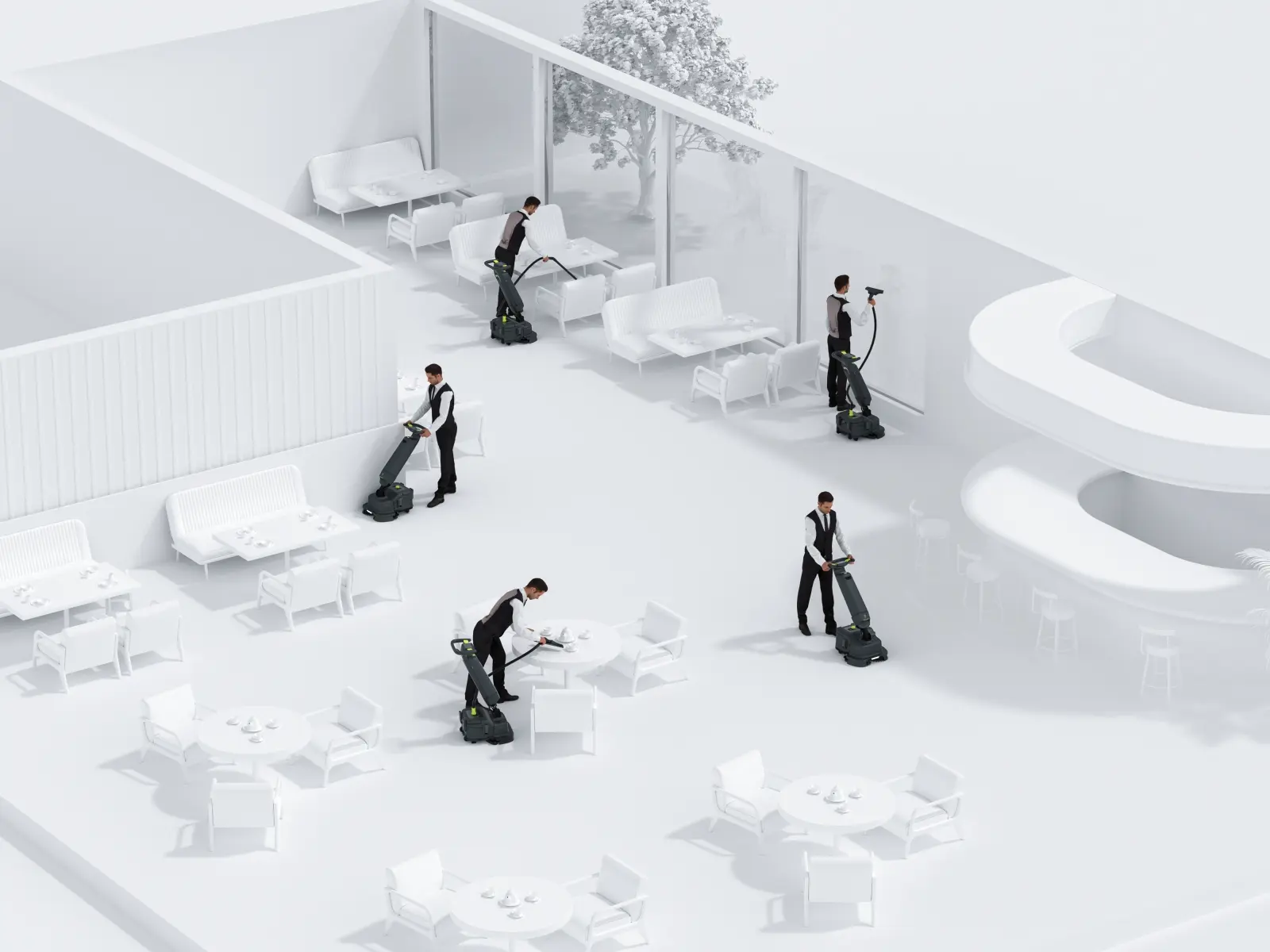
From mop to machine to robot: finding the middle ground
Robots grab the headlines, and they are changing the industry. However, they shouldn’t overshadow a quieter shift: conventional cleaning machines have become smaller, easier to use and incredibly worthwhile on far more sites.
There’s a wide middle ground between fully manual and fully autonomous cleaning. A single FM operation might use:
- Upright scrubber-dryers in washrooms, kitchens and tight spaces
- Walk-behind scrubber-dryers across medium-sized floors
- Ride-on machines across large halls and warehouses
- Sweepers in warehouses, car parks and outdoor areas
- Cleaning robots on long, repetitive routes that run for enough hours each day
The future of cleaning isn’t a choice between manual and robotic. It’s about matching the right level of mechanisation to each task.
Two developments made this possible
So why are machines suddenly making sense in places they previously didn’t? It comes down to two big leaps in the equipment itself.
Smaller Machines: Machinery used to mean finding storage for a bulky scrubber-dryer, arranging charging and having enough open floor to make the purchase worthwhile.
Today’s compact machines work comfortably in shops, schools, hotels, healthcare facilities and offices. You no longer need thousands of square metres of open floor to justify purchasing a machine.
Better Batteries: Modern lithium batteries charge faster, last longer and remove the need for trailing cables. Machines move easily between areas, stay available for more of the day and fit everyday cleaning routines instead of being an occasional specialist tool.
The cleaning machines Purozo supplies and what each does best
Every site is different and comes with its own needs, so Purozo stocks a full range from compact uprights to ride-on cleaning machines. Let’s take a look at what key benefits each machine can bring to a site:
Cleaner results, fewer repeat jobs
Productivity isn’t just about speed. A traditional mop can push dirty water around the floor unless the process is tightly controlled. A scrubber-dryer applies cleaning solutions, scrubs the surface and recovers the dirty water in a single pass.
This results in a more consistent clean and a floor that’s dry almost straight away. It also means less disruption in busy buildings, lower slip risk and fewer areas needing a second go.
Robust, easy to use and good value: the Genius range
Not every site needs the most complex machine on the market. Most cleaning teams want something robust, simple to operate and worth the initial investment. Above all, it needs to be a machine that the team actually uses.
That’s where the Genius range comes in.
From the compact G14B for narrow aisles to the G40RB ride-on for the largest floors, Genius offers an easy, cost-effective route into mechanised cleaning.
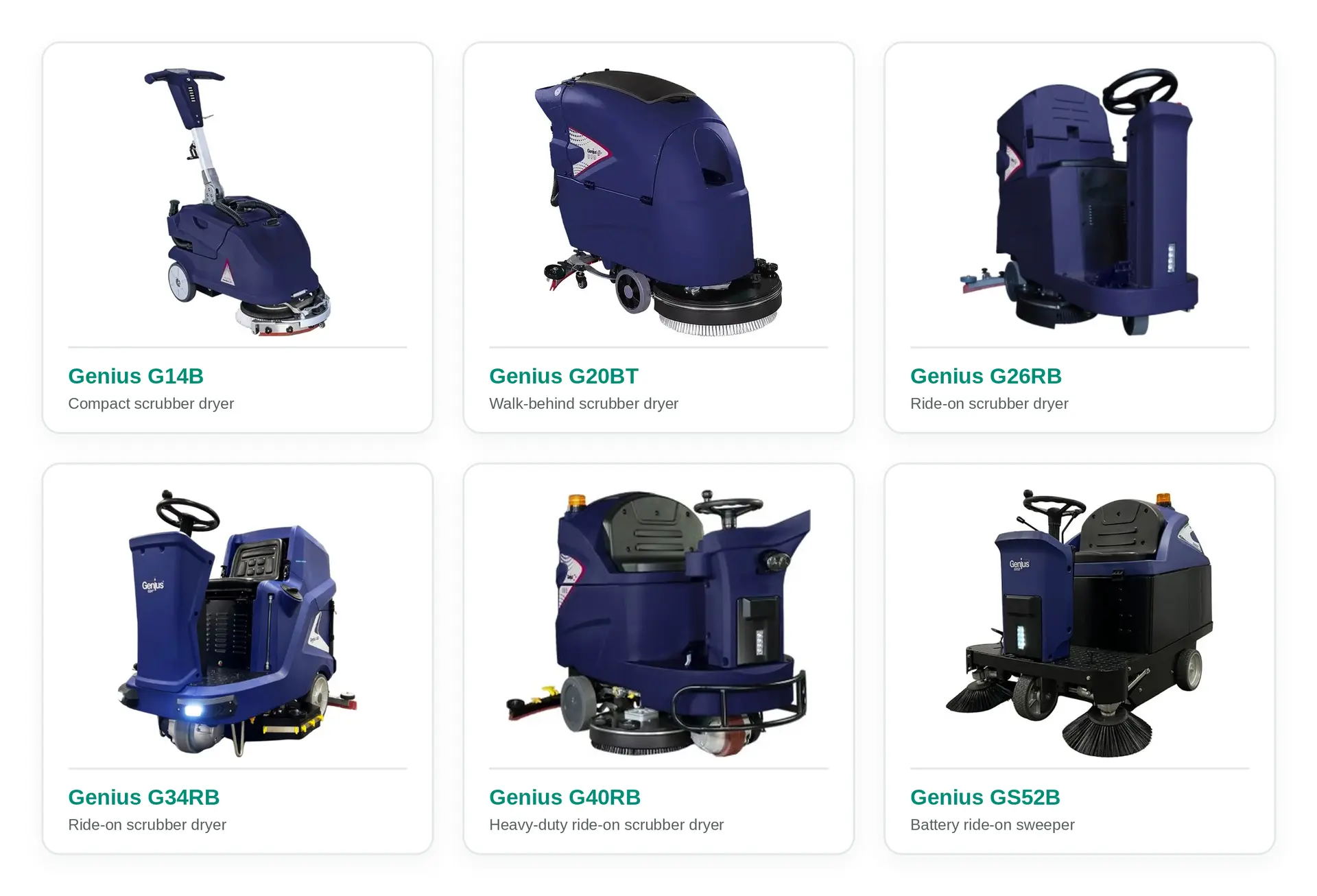
Ease of use really matters. A machine only delivers the productivity gains you planned for if your team members are comfortable taking it out of the cupboard and putting it to work. Fiddly controls or long training can undermine the business case before it starts.
Where cleaning robots fit
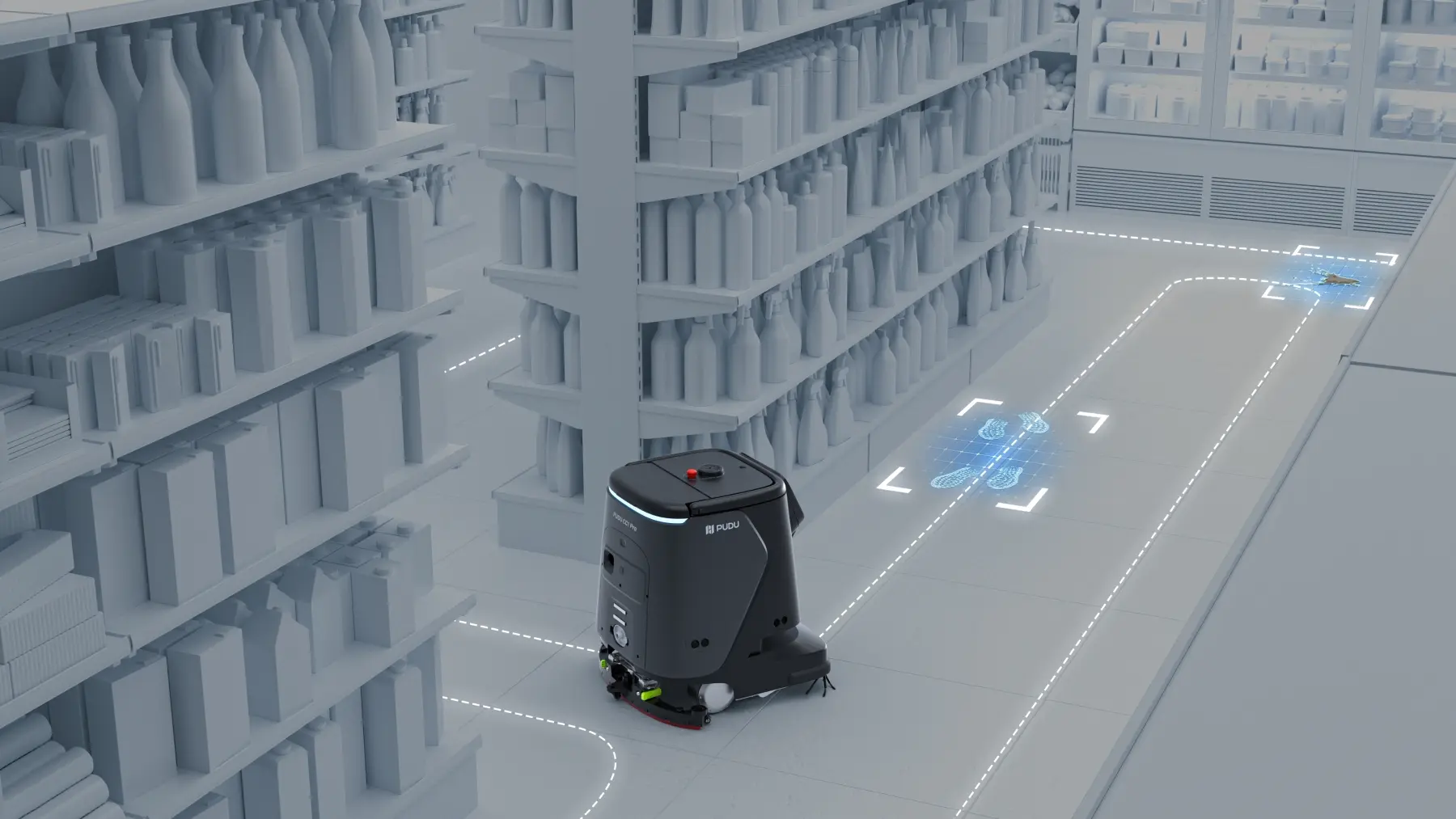
A cleaning robot is a machine that runs without an operator, making it best suited to large or long, repetitive routes that need cleaning every day. Having a robot do the task can free up your team for the work that people can do better.
How commercial cleaning robots work
Cleaning robots aren't as complicated as they might sound. Once they're set up, most follow the same simple routine:
- Mapping: The robot learns your building’s layout and cleaning routes during setup.
- Scheduling: You set cleaning jobs and times, including overnight or before opening to reduce disruption.
- Safe Navigation: Sensors detect people, trolleys and other obstacles to steer around them.
- Docking: Selected models return to a station to charge and, on some, to fill and drain water automatically.
- Reporting: You can see what was cleaned and when, which helps with audits and specifications.
The PUDU range from Purozo
Purozo supplies the PUDU range across the UK from small scrubber-dryers to large sweepers:
Robots and machines work best together
A medium or large-sized robot excels at the long, predictable sweep of a supermarket aisle or warehouse floor. However, it won’t tackle a spill in a narrow stockroom, tight washroom or a flight of stairs.
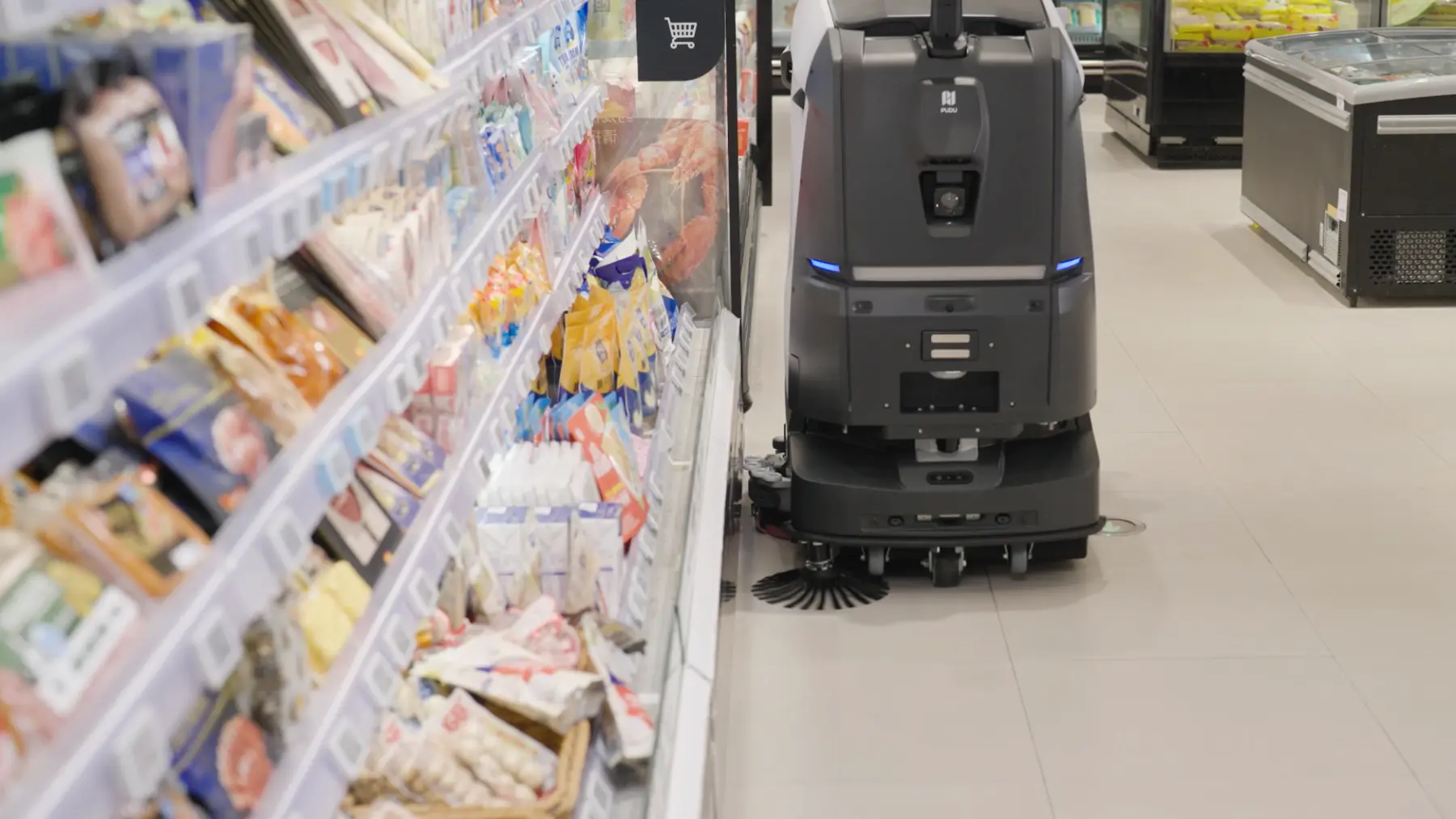
Pair robots with compact machines and a skilled team to ensure every part of the building gets the right level of consistent care.
Which buildings suit robots and machines?
Most commercial buildings now have at least one area where machinery earns its place. Here is where each type of robot and machine can excel:
- Warehouses & Distribution Hubs: Ride-on scrubber-dryers and sweepers work best for the main floor with robotic sweepers, like the PUDU BG1, completing long, repeatable routes.
- Retail & Shopping Centres: Walk-behind scrubber-dryers for daily floor care with robots like the PUDU ET1 or PUDU CC1 cleaning aisles before opening.
- Hotels, Restaurants & Venues: Compact upright scrubber-dryers are ideal for kitchen areas and back-of-house with vacuums and carpet cleaners for guest areas.
- Offices & Co-Working Spaces: Robot vacuums for open-plan carpeted floors alongside compact scrubber-dryers for kitchens and reception areas.
- Schools, Colleges & Universities: Walk-behind scrubbers for corridors and halls with robots to keep large areas consistently clean during term times.
Not sure where your building fits? The cleaning machines by environment hub groups every cleaning machine by the space it works in.
Building the business case: look beyond the purchase price
Capital cost is the most common reason sites stick with manual cleaning. A mop and bucket costs very little, while a commercial machine or robot is a bigger financial commitment. Based on purchase price alone, the mop and bucket always looks cheaper.
However, you aren’t just buying equipment. You’re buying a cleaning outcome that lasts for several years. A fairer comparison sets the two options side by side over the same period:
Once labour is included in the cost, the gap often narrows considerably. On the right site, a machine that looks expensive at first can recover its cost through the hours it frees up. Every building is different, which is why a proper site assessment matters.
Utilisation makes or breaks the case
A cleaning machine used for 20 minutes a week rarely represents good value. With labour costs rising, the number of productive hours a machine needs to justify itself falls. Robots add a further advantage: they can run outside staffed hours, so their working day isn’t limited by your rota.
For FM providers managing several buildings it’s worth thinking beyond a single site. A machine that doesn’t stack up for one small location may make perfect sense shared across several buildings or contracts.
Ask the design-from-scratch question
The biggest opportunity often isn’t replacing an old machine with a newer one. It’s rethinking areas that have never been mechanised at all.
Many cleaning specifications have grown up over the years. A corridor gets mopped because it has always been mopped. So it’s worth asking:
“If we were designing this cleaning operation from scratch today, would we still do it this way?"
Sometimes the answer will be yes. Manual cleaning remains essential, and some spaces will always be best served by people, simple equipment and good technique. However, increasingly, the honest answer is no and that is the time to re-evaluate practices.
Sustainability strengthens the argument
Facilities teams are increasingly being asked to show progress on sustainability without letting standards slip. The good news is that productivity and sustainability don’t have to compete with each other.
When correctly specified and operated, modern machines and robots can help cut water and chemical use through controlled dosing and repeatable cleaning programmes. Pair them with lower-impact products such as concentrates and on-site cleaning solutions and the whole operation becomes leaner.
Read more about our approach to sustainability.
Demos, training and servicing: all from one UK team
The right machine is only half the story. It needs to be set up properly, used confidently and kept running. With Purozo, every stage is handled in-house by our own team, rather than passed on to third parties. We offer:
- Site Assessments: We look at your floor types, cleaning areas, routes and working patterns.
- On-Site Demos: See a machine or cleaning robot working on your own floors before you commit.
- Setup & Operator Training: Your team will receive practical, on-site training which includes mapping, scheduling and everyday use, so they can feel confident from day one.
- Servicing & Replacement Parts: Our machinery team can provide UK-based maintenance as well as replacement parts like brushes, pads, filters, squeegees and docking stations to keep machines working.
Frequently asked questions about commercial cleaning machines and robots
Choosing the right commercial cleaning machine can raise a lot of questions, from deciding which type suits your site to understanding maintenance, floor compatibility and day-to-day use.
Below, we’ve answered some of the most common questions businesses ask when comparing commercial cleaning machines:
1. Will a cleaning robot replace my cleaning team?
No. Robots take on long, repetitive floor routes so your team can focus on washrooms, touchpoints, spills and detail cleaning. Most sites use robots alongside people and conventional machines.
2. Is my building big enough for a cleaning machine?
Most likely, yes. Compact scrubber dryers and robots, like the PUDU ET1, are designed for smaller spaces, not just warehouses. For example, the ET1 suits spaces of roughly 100 to 800 m².
3. What is the difference between a scrubber-dryer machine and a cleaning robot?
A scrubber-dryer machine is driven or pushed by an operator while a robotic scrubber-dryer does the same job autonomously, following mapped routes on a pre-set schedule.
4. Can I see a machine working before I decide?
Yes. Purozo offers on-site demonstrations so you can see a machine or robot on your own floors.
5. Do you provide training and servicing on machines and robots?
Yes. Operator training, servicing and genuine replacement parts are all provided by our in-house UK team.
The economics of cleaning have changed
Cleaning machinery was once all about the biggest spaces and floors. Today, the conversation is much broader including key points like:
- Labour productivity
- Consistency
- Less repetitive physical work
- Lower water and chemical use
- Better use of your team’s hours
The machine that couldn’t be justified 5 or 10 years ago due to cost may make far more sense today. As labour costs rise and technology improves, that threshold will only keep moving.
The real question for FM is no longer where machines can replace manual cleaning. It’s where the right combination of people, machines and robots delivers better results at a lower overall cost.
Ready to find the right balance for your site? Speak to our team to arrange a site assessment or demo or explore our cleaning robots.